

I’ve been thinking lately about the stock market and how resilient it’s been during these turbulent geopolitical times. The Russia-Ukraine war has been ongoing for four years. The US conflict with Iran continues without an end in sight. Gas prices are skyscraper high. Consumer confidence is about as low as it’s ever been. A new tariff war seems to erupt every other week.
And AI is apparently going to kill us all.
Doesn’t sound great, huh? Yet, the stock market keeps chugging along. After three straight years of the market gaining at least 17%, it appears that another double-digit gain is possible, if not probable, for 2026.
It didn’t use to be this way.
[AUTHOR'S NOTE: I’ve always loved history. I’ve always loved the idea of taking a peek into the past and studying it from the current-day perspective. The idea of time travel also fascinates me. With my passion for writing about finance, I’m combining all of it together in an occasional column for WCI called “The Financial Wayback Machine.”
I want to journey back in time and look at those supposedly great ideas that now seem ridiculous, all the good and terrible predictions (crystal balls have never not been cloudy), the doctors who did great (and shady) things, and all the seemingly minor news nuggets that ended up making huge waves. It’ll be fun, it’ll be silly, and maybe it’ll be a good lesson for what not to do with your money today.
After all, as WCI Founder Dr. Jim Dahle once said, “If you've never read history, you're destined to repeat it.”
Step into the Financial Wayback Machine with me, and let’s travel back in time.]
How the Soviet Union’s Sputnik Launch Affected US Stocks
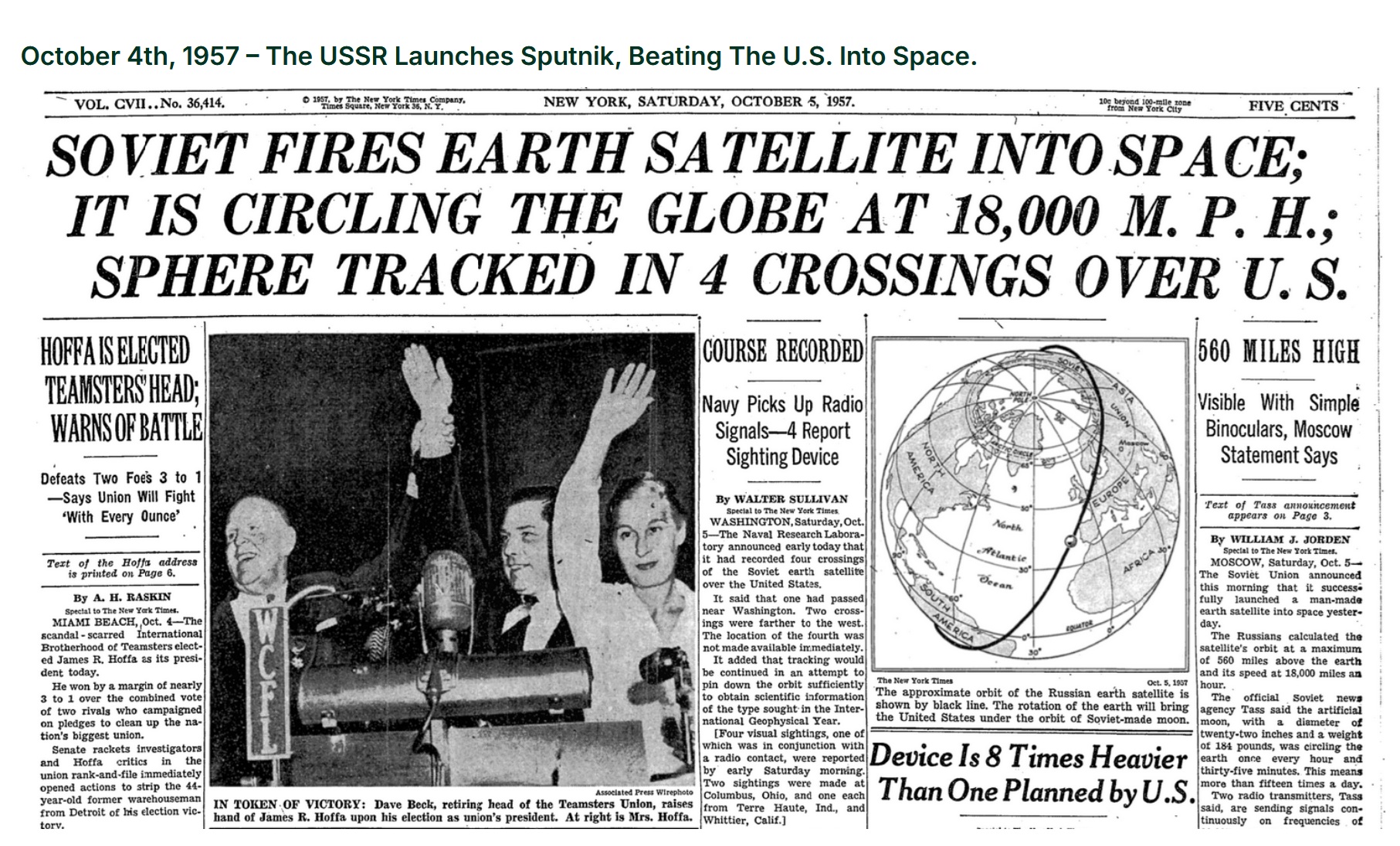
On Oct. 4, 1957, 69 years ago today, the USSR won the first early battle of the space race, sending the unmanned Sputnik I into orbit for three months. The Russian satellite was about the size of a beach ball and only weighed 184 pounds, but it had an oversized impact on the US’s feelings of vulnerability and on the stock market.
“The Sputnik launch changed everything,” NASA noted. “As a technical achievement, Sputnik caught the world's attention and the American public off-guard . . . The public feared that the Soviets' ability to launch satellites also translated into the capability to launch ballistic missiles that could carry nuclear weapons from Europe to the US.”
Here’s how the New York Times looked that day, via Begin to Invest. Also notice who was elected that day to run the Teamsters union. Pretty historic day on two fronts, eh?
The stock market blinked with news of the Russian satellite. A day before Sputnik pierced the sky, the Dow Jones Industrial Average was at 465.82. On Oct. 10, the Dow industrials fell 9.69 points, its biggest setback since President Eisenhower suffered a heart attack two years earlier. On Oct. 21, the stocks fell nearly 11 points more.
“Brokers and traders blamed the drop partly on US government complacency in the wake of Sputnik; the Pentagon announced plans to cut aircraft procurement, which struck many people as unwise, given the technological prowess the Soviets had just displayed,” the Wall Street Journal noted in 1996.
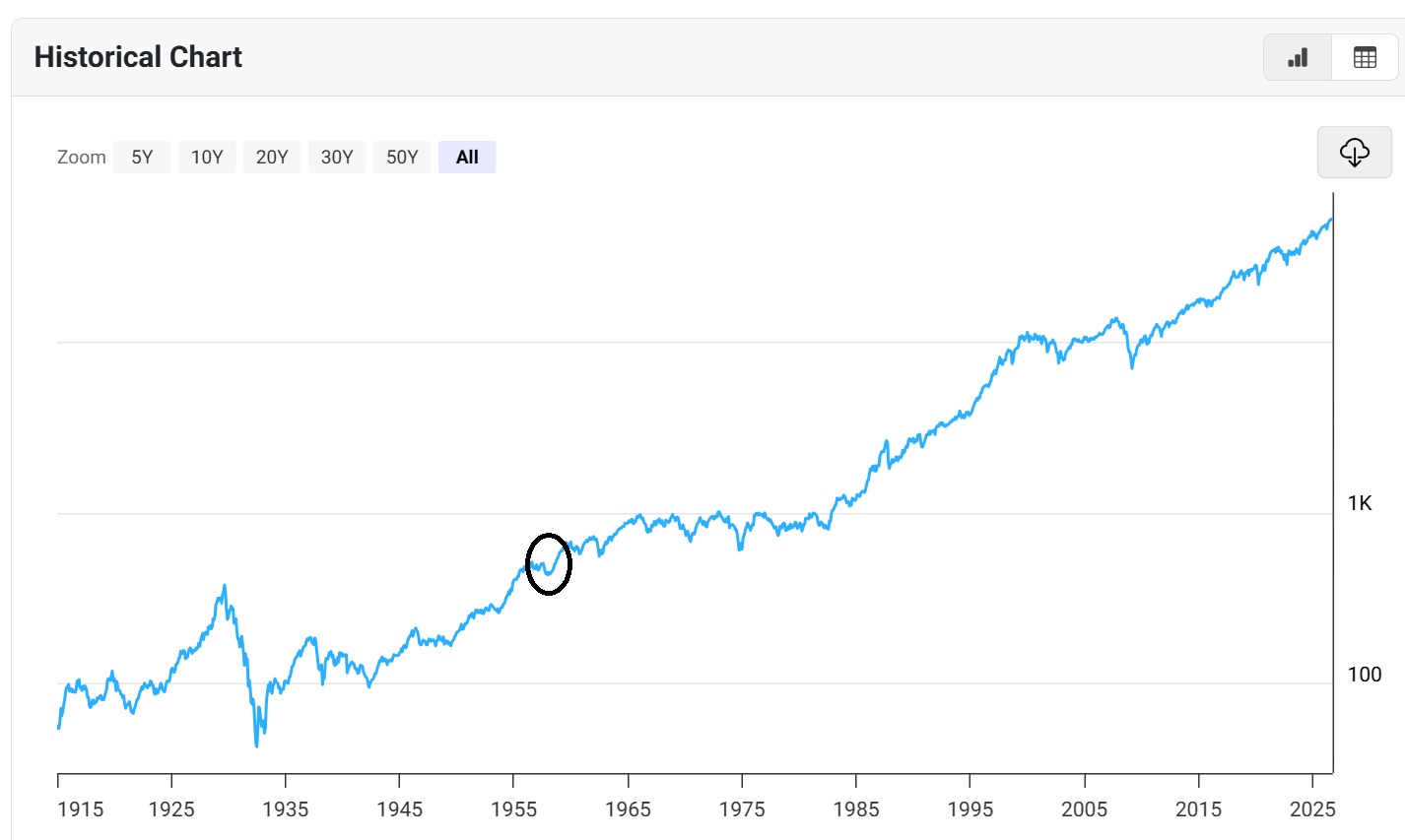
Three weeks after Sputnik drew first blood in the space race, the Dow Jones had tumbled by nearly 10%. The stock market wouldn’t recover those losses until May 1958.
Even before Sputnik, the stock market had dropped more than 20% since July 1957. The Civil Rights era had begun. The Cold War was heating up. Much like today, America was experiencing domestic and international turbulence.
In the grand scheme, the Sputnik dip didn’t matter much. Here’s a historical chart to put it in perspective.
Meanwhile, I read articles every week from writers waiting and wondering if the AI bubble is set to burst. I wrote about it two years ago. So far, the bubble, if that’s what it is, has held strong. Our 401(k)s and my disbelief, much like Sputnik, continue to rise. But some people believe that the race for AI is the new space race and that China is the new Soviet Union. The US lost that first battle in the space race seven decades ago, and the stock market responded accordingly. What will happen if something similar happens with AI?
We might have gotten a glimpse at the answer in 2025 when little-known Chinese AI startup DeepSeek released a chatbot that “experts say holds its own against industry leaders, like OpenAI and Google, despite being made with less money and computing power.”
The response: the NASDAQ dropped more than 3%, and Nvidia lost nearly $600 billion in market value in a single day, the largest one-day loss in US history. Since then, the tech-heavy NASDAQ and Nvidia have rebounded, but with news like that, it makes you wonder if another Sputnik-like event will have another oversized effect on the market.
Do No Harm
I love watching doctor commercials on YouTube. Especially those from the 1950s when they endorse smoking and other harmful activities.
In the video below, I’m not entirely sure what a doctor killing a fly in this manner has to do with a mortgage company (also, is it weird they just have the defibrillator pads in the room of a random patient who’s been diagnosed with a broken leg?).
But I can tell you that slaying a fly this way is only slightly less cool than how Mr. Miyagi could do it with chopsticks.
Seriously, though, showing dead insects in your commercial probably isn’t going to make me want to purchase my home through you. For the record, Ameriquest, one of the largest subprime mortgage lenders around, shut down during the Global Financial Crisis of 2007-08. There’s probably a lesson somewhere in there.
More information here:- How This Respected Doctor Tried to Bring George Washington Back to Life
- How a Morally Dubious Dentist Changed The Beatles’ Sound
- A Doc Created the Coolest Shoe in the Whole World
- The Most Athletic Doctor Ever
Money Song of the Week
The idea that scares so many of us about a potential AI bubble is that it could trigger the US economy into a recession or, even worse, another great depression. That’s why today I’m highlighting the 1932 version of Brother, Can You Spare a Dime by Rudy Vallee, a tune that tells the tale of bleak economic times when even those who went through hell fighting in the first World War and those who helped build the tallest buildings in the world still found themselves waiting in bread lines.
As Vallee sings,
“Once I built a railroad, I made it run/Made it race against time/Once I built a railroad, now it's done/Brother, can you spare a dime?
Once I built a tower up to the sun/Brick and rivet and lime/Once I built a tower, now it's done/Brother, can you spare a dime?”
I mean, have you ever heard a horn section sound so morose and helpless? And this was only a few years after the era of The Great Gatsby and New Money. While other popular songs of the day tried to keep Americans in a good mood despite the bleak economic clouds that covered the tops of those towers up to the sun, the songwriters, E.Y. “Yip” Harburg and Jay Gorney, took a different approach.
As they toiled away on the song, they were still in search of a title. The duo took a break in Central Park in New York. According to the Kennedy Center,
“A young man approached Gorney, his collar turned up and his hat pulled low. ‘Buddy, can you spare a dime?’ he asked. The two songwriters glanced at each other and knew they’d found the words they’d been searching for. Brother, Can You Spare a Dime? immediately hit a nerve in Americans’ hearts and minds . . . For the first time since the Great Depression began, it seemed, someone had put words and music to what many Americans were feeling—fear, grief, even anger.”
For what it’s worth, 10 cents from 1932 is worth about $2.50 today, so the title would have to be changed to Brother, Can You Spare 25 Dimes? Which feels a little greedy (and a little wordy).
Anyway, the bourgeoisie class of the early 1930s was not pleased.
“The song itself, though, angered some rich and powerful Americans. Pro-business leaders believed the tune was a dangerous attack on the American economic system. They tried to ban it from Broadway and block it from being played on the radio. But it was too late: The song’s popularity drowned out all grumbling.”
Singing truth to power can be a courageous act, and even nearly 100 years later, you can see how this song could be the anthem of a generation that was tired, dirty from soot and dust, and still very, very poor.
More information here:Reel of the Week
Being a doctor is so very glamorous, right?
Are you worried about an AI bubble? Or do you think the stock market will keep chugging away?
Did you find this article helpful? Share it!